

 English
 Español
 عربى







Content
- 1 What Is a Dual Fuel Range?
- 2 Why Pair a Gas Cooktop with an Electric Oven?
- 3 Dual Fuel vs All-Gas vs All-Electric: Which Should You Choose?
- 4 What to Look For When Buying a Dual Fuel Range
- 5 Typical Dual Fuel Range Burner Layout
- 6 Ventilation: Match the Hood to the Heat Output
- 7 Dual Fuel Range or Rangetop + Wall Oven?
- 8 Dual Fuel Range FAQ
Dual fuelGas cooktopElectric ovenPro-style sizes
Your kitchen plan shows a 36-inch opening, a gas line on the left, and a 240V outlet tucked behind the cabinet. The final decision is between all-gas and dual fuel. A dual fuel range settles it: gas burners on top for instant, visible heat control, and an electric oven below for steady, even baking. It is not the cheapest configuration, and the installation is slightly more demanding, but it removes the biggest compromise from a pro-style cooktop and oven package.
What Is a Dual Fuel Range?
A dual fuel range is a single cooking appliance that uses two energy sources: gas feeds the surface burners and electricity powers the oven. The cooktop behaves like a professional gas rangetop, with flame control that goes from a bare simmer to a hard sear. The oven uses electric bake and broil elements, which produce drier and more evenly distributed heat than a gas flame inside an enclosed cavity.
The term "dual fuel" refers to this specific cooktop-and-oven split. It is not a "dual-source" oven that mixes gas and convection in one cavity. For most buyers, the distinction matters less than the outcome: you get the responsive cooking surface of gas and the predictable baking environment of electricity in a single footprint.
Dual fuel ranges follow the standard pro-style width ladder of 30, 36, and 48 inches. A 36-inch dual fuel range, for example, typically fits six burners and a 5.5 cubic foot oven, which is enough for a serious home cook or light commercial use.
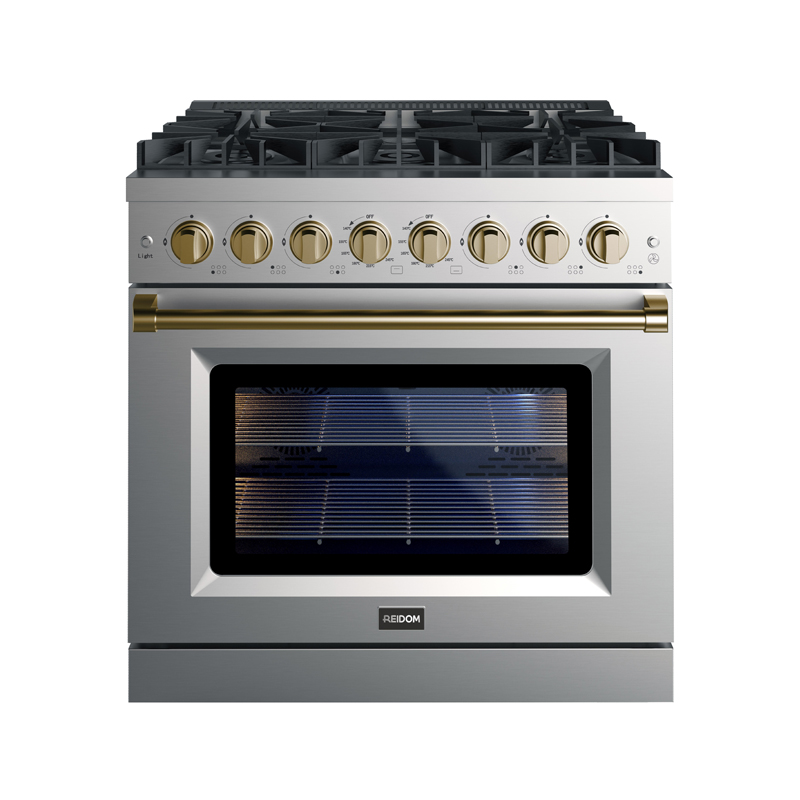 Reidom 36-Inch All Gas Range with Six Burners and Convection OvenThis black-painted gas range pairs six burners with a 5.5 cubic foot convection oven, fitting kitchens that prioritize rapid high-heat cooking on the cooktop over electric baking.View Product →
Why Pair a Gas Cooktop with an Electric Oven?
The reason is practical. Gas burners handle tasks that need rapid response: searing meat, stir-frying in a hot wok, or holding a sauce at a bare simmer. Electric ovens handle tasks that need consistency: cakes, bread, roasted vegetables, and long braises. A dual fuel range lets you choose the right tool for each job without moving between two appliances.
| Aspect | Gas oven | Electric oven |
|---|---|---|
| Temperature stability | Wider swings during cycling | Tighter control around the set point |
| Oven humidity | Higher due to combustion air | Drier heat, better for browning |
| Baking evenness | Hot spots near the flame | Balanced top and bottom heat |
| Preheat speed | Often faster | Slightly slower but predictable |
| Broiling | Flame broiler, uneven by design | Dedicated element, more even |
These differences show up in actual meals. A gas oven can be excellent for a pizza stone or a charred roast, but it punishes delicate batters. An electric oven holds a steadier temperature, which is why most pastry recipes assume electric heat or give separate instructions for gas.
The electric oven in a dual fuel range stabilizes humidity and temperature so you can reproduce the same baking results week after week. That consistency is the single biggest reason cooks switch from all-gas.
Dual Fuel vs All-Gas vs All-Electric: Which Should You Choose?
Start with the decision rule. Choose all-gas when you rarely bake and want the least complicated installation. Choose all-electric when no gas line is available. Choose dual fuel when you cook with gas burners daily and want a dependable electric oven without adding a second appliance.
| Consideration | All-gas | Dual fuel | All-electric |
|---|---|---|---|
| Cooktop control | Instant, visible flame | Instant, visible flame | Slow heat-up and cool-down |
| Oven performance | Acceptable, less even | Stable and even | Stable and even |
| Utilities needed | Gas line only | Gas line + 240V outlet | 240V outlet only |
| Best fit | Traditional cooks who rarely bake | Cooks who want both strengths | Kitchens without a gas supply |
The installation detail is what most buyers miss. An all-gas range needs only a gas connection. A dual fuel range needs that gas connection plus a dedicated 240V circuit for the oven elements. Many homes already have both at the range position because the previous range was electric; older homes with gas-only wiring may need an electrician. Add that cost to the comparison before you commit.
What to Look For When Buying a Dual Fuel Range
Work through size first, then configuration. The width determines burner count and oven volume. You can compare 30-, 36-, and 48-inch configurations in our range collection to see the exact models available.
| Range width | Typical oven capacity | Typical burners | Good for |
|---|---|---|---|
| 30 inches | 4.6 cu ft | 5 | Standard home kitchens |
| 36 inches | 5.5 cu ft | 6 | Large home kitchens |
| 48 inches | 7.0 cu ft | 8 | Heavy home or light commercial use |
30-inch dual fuel ranges
A 30-inch model fits the footprint of a standard residential stove, so it is the dual fuel option for kitchens that cannot take a wider cutout. You still get five burners and roughly 4.6 cubic feet of oven space, which covers most family cooking.
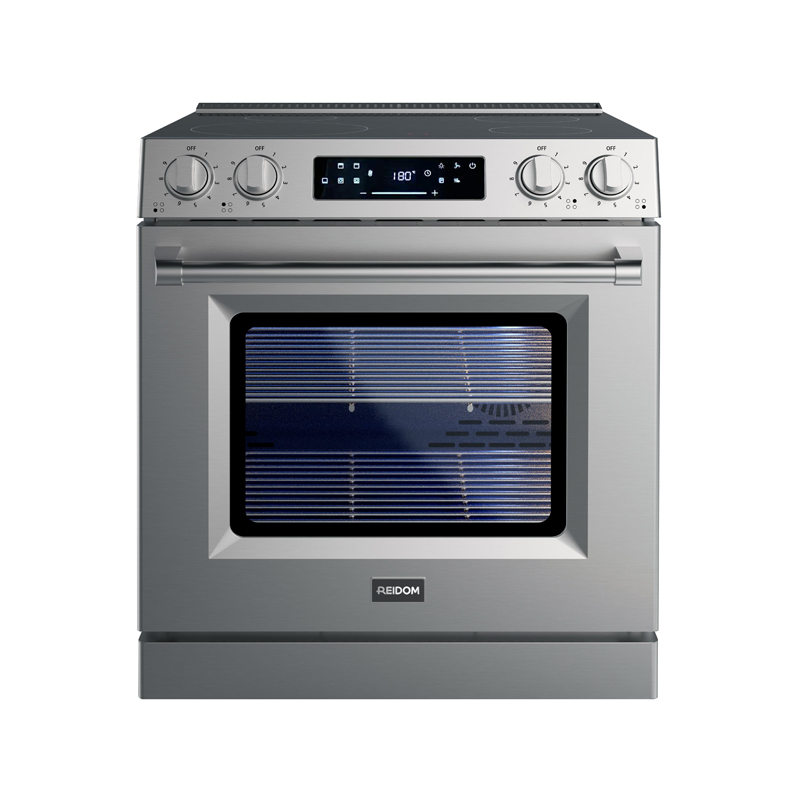 Reidom 30-Inch Electric Range with Five Induction Elements and Convection OvenWith five induction elements and a 4.6 cubic foot electric oven, this 30-inch range suits standard residential cutouts while offering precise cooktop control and consistent baking heat.View Product →
36-inch dual fuel ranges
Thirty-six inches is the default pro-style width and the configuration we build most often for serious home kitchens and small commercial prep lines. Six burners and about 5.5 cubic feet of oven capacity give you the burner real estate to run two pans and a large pot at the same time.
48-inch dual fuel ranges
A 48-inch range is a different commitment. Eight burners and roughly 7 cubic feet of oven volume suit large gatherings or a light commercial setting where one range carries the whole kitchen. It also demands a wider cutout and stronger ventilation, so verify the hood before ordering.
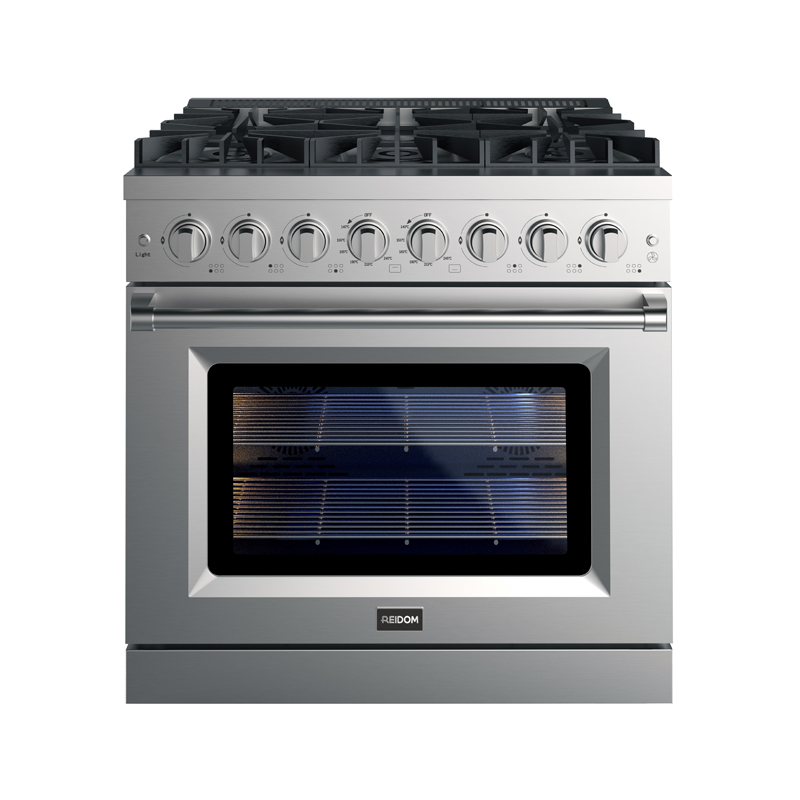 Reidom 36-Inch Dual Fuel Range with Six Gas Burners and Electric OvenThis stainless dual fuel range combines a six-burner gas cooktop with an electric convection oven, giving serious cooks the fast response of gas and the steady heat needed for even baking.View Product →
Beyond size, check these details on any dual fuel model:
- Maximum burner output: look for at least one burner in the 15,000 BTU class for wok-style searing, plus a low-output burner below 5,000 BTU for sauces.
- Oven modes: convection, broil, and proofing or dehydrate settings add real value beyond a plain bake element.
- Grate design: continuous cast-iron grates let you slide heavy pots across the cooktop without lifting.
- Cutout dimensions: compare the required cutout width, depth, and side clearance with your countertop before delivery.
- Control layout: knob position matters during long cooking sessions, so sit with the control panel if you can.
Typical Dual Fuel Range Burner Layout
maximum outputs shown as 1,000 BTU units for pro-style 36-inch models.A 36-inch layout like this gives you two high-output front burners, a versatile center burner, and rear burners for long simmers. The exact burner placement varies by model, so confirm the pattern and the output of each position before you order.
Ventilation: Match the Hood to the Heat Output
A high-output gas cooktop produces heat, moisture, and combustion byproducts that a recirculating hood cannot clear. The practical rule is to total the BTU output of all burners and divide by 100 to get the minimum CFM. A 36-inch six-burner dual fuel range with roughly 65,000 BTU total output needs about 650 CFM, and a 48-inch eight-burner model often lands at 900 CFM or more.
Hood width should be at least as wide as the range, and 6 inches wider is better for wall-mounted installations. Duct length and elbows reduce effective airflow, so the filter rating alone is not the whole story. Our step-by-step range hood sizing guide covers CFM, width, and duct loss in detail.
Dual Fuel Range or Rangetop + Wall Oven?
Some kitchen layouts use a separate gas rangetop and a wall oven instead of a single range. The split gives flexible placement and puts the oven at eye level, but it costs more in equipment, cabinets, and installation, and it consumes more wall space.
A dual fuel range delivers the same fuel combination in one simpler package. The practical question is whether the eye-level oven and extra surface space are worth the added cost. If you are still comparing layouts, read our breakdown of the difference between a gas rangetop and a full range to understand the everyday usage and installation trade-offs.
Dual Fuel Range FAQ
Q1: Is a dual fuel range worth the extra cost?
For most cooks who bake or roast regularly, yes. You pay more than an equivalent all-gas model, but the electric oven improves temperature stability in the same footprint. If you rarely use the oven, an all-gas range is the more economical buy.
Q2: Can a dual fuel range be installed in a standard home?
It needs both a gas line and a 240V outlet at the cutout. Many homes already have both because the previous range was electric or the gas range used electric ignition. If the 240V line is missing, add an electrician's quote to your budget; in some regions that can run several hundred dollars.
Q3: Do dual fuel ranges use more energy than all-gas models?
Electric ovens generally heat more efficiently than gas ovens because less heat is lost to combustion venting, though local electricity rates vary. The cooktop half remains gas, so surface cooking costs do not change. Expect the oven portion to behave like a good electric oven in running cost.
Q4: What CFM hood do I need for a dual fuel range?
Add the output of all burners and divide by 100. A 36-inch model with roughly 65,000 BTU total output needs a minimum of about 650 CFM, and a 48-inch model benefits from 900 CFM. Install the hood at the recommended height and keep the duct run short to preserve airflow.
Dual fuel is not a marketing label; it is a deliberate division of labor. Gas handles what gas does best — instant, visible cooktop control — and electricity handles what electric ovens do best — even, stable baking heat. Confirm the gas line, the 240V outlet, the cutout width, and the ventilation capacity before you order. When those four conditions are met, a dual fuel range becomes the most useful single appliance in the kitchen.
