

 English
 Español
 عربى







Content
- 1 Why Stainless Steel Is Oven-Safe
- 2 What Temperature Can Stainless Steel Withstand?
- 3 How to Check If Your Stainless Steel Pan Is Oven-Safe
- 4 Situations Where Stainless Steel Should Not Go in the Oven
- 5 How Stainless Steel Kitchen Equipment Behaves in High Heat
- 6 Practical Takeaways for Buying Stainless Steel Cookware
- 7 Conclusion: Oven-Safe Does Not Mean Indestructible
- 8 Frequently Asked Questions
You are about to slide a stainless steel roasting pan into a 450°F oven. Should you stop? No. Stainless steel is one of the most oven-safe cookware materials available, and professional kitchens have relied on it for decades. However, the full answer is not a simple yes. The oven-safe ceiling depends on three things: the grade of the steel, the handle and lid construction, and any nonstick coating glued to the surface.
Why Stainless Steel Is Oven-Safe
Stainless steel is an alloy of iron, chromium, and nickel. The chromium content forms a passive oxide layer that protects the metal from rust. Unlike aluminum or copper, stainless steel does not soften or warp at normal oven temperatures. The main structural grades used in cookware—304 and 316—have melting points above 2,500°F (1,370°C). A home oven maxes out around 550°F (288°C). So the metal itself is never the weak link.
What makes a pan "oven-safe" in practice is the full assembly. For example, an all-steel skillet with a riveted steel handle can go from stovetop to broiler without a second thought. But if the same pan has a silicone-wrapped handle rated to only 450°F, that becomes the limit. Similarly, a glass lid may be rated to 390°F, while a metal lid might withstand 500°F. Reading the manufacturer's marking is the only reliable way to know.
What Temperature Can Stainless Steel Withstand?
There is no universal number because stainless steel cookware is assembled with multiple materials. Still, you can plan around common figures used across the industry.
Typical stainless steel cookware: 500°F (260°C)
Pans with silicone handles: 450°F (232°C)
Pans with glass lids: 390°F (199°C)
Pans with nonstick interior: 400–500°F (204–260°C)
The difference between 390°F and 500°F often matters more than most home cooks realize. If you are searing a steak and then transferring the pan to a 475°F oven to finish, a glass lid can crack. If you are roasting vegetables at 450°F, a nonstick-coated stainless steel pan may start to release fumes or lose its coating. The safest approach is to check the bottom stamp, insert your pan into a cold oven, and heat both together for high-temperature work.
How to Check If Your Stainless Steel Pan Is Oven-Safe
Manufacturers mark oven safety in a few clear ways. First, look on the bottom of the pan or the underside of the handle. You will often see a logo, the material grade, a dishwasher symbol, or a temperature range like "400°F / 200°C." If the marking says "oven-safe to 500°F," you can trust that number for the entire piece—including the handle. If the marking is missing, examine the handle material: a solid stainless handle cast as one piece with the pan is almost always safe to 500°F or more; a plastic or silicone handle is the limiting component.
Second, test the lid if it is not made of metal. Tempered glass lids generally tolerate moderate oven heat, but they are still the most failure-prone part. Third, inspect the coating. A stainless steel pan with a nonstick layer will have a separate oven-safe rating from the same pan in bare stainless. This is a common source of confusion because many people assume the metal determines the limit.
For any food service equipment you purchase for a commercial kitchen, look for the same kind of labeling. When you are planning an open kitchen or a high-volume cooking line, the oven-safety of your pans is only half the equation; the equipment surrounding those pans must handle the same heat environment. That is why the guide to stainless steel kitchen appliance durability covers material thickness, construction, and real-world heat exposure.
Situations Where Stainless Steel Should Not Go in the Oven
Stainless steel is oven-safe, but exceptions exist. Do not put a stainless steel pan in the oven if it has any of the following:
- A handle made of wood, Bakelite, or soft plastic rated to a lower temperature. In a 500°F oven, these handles can scorch, melt, or crack.
- A lid with a plastic knob or rubber gasket. The knob may soften before the pan reaches the desired temperature.
- A nonstick coating that has begun to peel or flake. High heat accelerates the breakdown of the coating and can release fumes.
- Rust, pitting, or deep carbon buildup on the surface. While the steel itself will not burn, heavy residues can smoke and alter the taste of food.
If you are unsure about a specific pan, do not jump straight to broiler temperatures. Start at 350°F and watch for any odor from the handle or lid. A pan that smells like plastic at 350°F will smell worse at 450°F.
How Stainless Steel Kitchen Equipment Behaves in High Heat
The same physics that makes a stainless steel skillet oven-safe applies to larger kitchen equipment. A professional range, a stainless steel worktable, or a range hood is built from the same 300-series steel. In a busy kitchen, the range top reaches far higher temperatures than any home oven, and the metal handles it without warping. That durability is why stainless steel is the default choice for commercial kitchens.
But there is a subtlety: the equipment itself must be designed for the heat source. A stainless steel range with a cast-iron burner grate and a fully welded body will perform differently from a thin-stamped consumer unit. When you are evaluating a range for your restaurant or commercial kitchen, you want to look at how the steel is joined, the thickness of the top plate, and whether the burner system is designed for continuous high-heat use. For kitchens that need a reliable high-heat range, look for a unit with a heavy-duty oven and a robust stainless steel body.
36-inch all-gas range with 5.5 cu. ft. oven capacity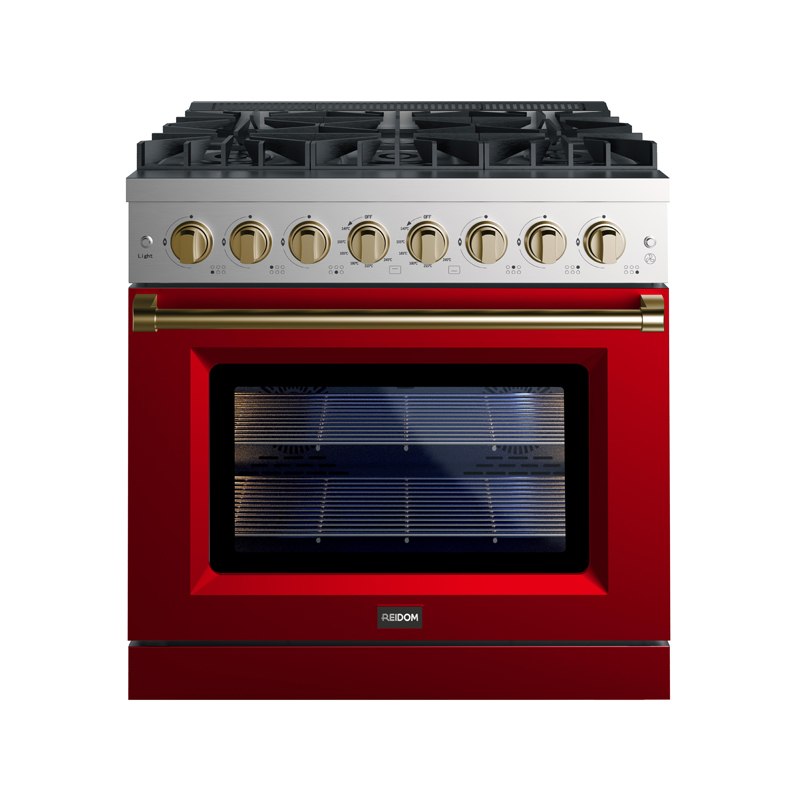 Reidom 36-Inch All Gas Range with 5-Burner Cooktop and Convection OvenThis gas range offers a heavy-duty stainless steel body and certified performance suitable for high-heat commercial cooking. With five burners and a gas convection oven, it provides reliable power for demanding kitchen environments.View Product →
Practical Takeaways for Buying Stainless Steel Cookware
When you shop for stainless steel cookware, do not just look at the size or the price. Ask specifically about the oven-safe temperature, the handle construction, and whether the product is certified by an independent test lab. In a commercial environment, the difference between a 450°F limit and a 500°F limit can decide whether your pans survive weekly service.
Also think about the interface between your pans and your range. If you are using a high-output gas range or a rangetop, the pans will receive uneven scorching heat that a lighter consumer pan may not tolerate. Pan thickness matters more than most people expect. A multi-ply or heavy-gauge stainless steel pan distributes heat more evenly, which reduces the chance of burnt edges and warped bottoms. For chefs who need flexibility between stovetop and oven, a dual fuel range provides that flexibility.
30-inch dual range with 4.6 cu. ft. oven Reidom 30-Inch Electric Range with Induction Cooktop and Convection OvenThis electric range features an induction cooktop and electric convection oven, delivering even heating and precise control. Its stainless steel finish and ceramic glass surface make it a versatile option for kitchens needing both stovetop and oven flexibility.View Product →
Conclusion: Oven-Safe Does Not Mean Indestructible
Stainless steel is oven-safe, but "safe" is a range, not a fixed point. The steel will never suddenly fail in a 500°F oven, but the handle, lid, coating, or seal might. Check your pan for a temperature marking, keep away from plastic components, and do not assume every stainless steel item is identical. For professional kitchens, the same logic applies to the bigger equipment: choose stainless steel that is built for heat, not just for looks. For high-volume kitchens, a 48-inch range with a large oven is a common answer.
48-inch all-gas range with 7 cu. ft. oven space Reidom 36-Inch Dual Fuel Range with Gas Cooktop and Electric OvenThis dual fuel range combines a five-burner gas cooktop with an electric convection oven, offering flexibility for various cooking techniques. The flip-style TFT screen adds modern convenience while maintaining professional-grade construction suitable for high-volume use.View Product →
If you are a restaurant owner or a kitchen designer, the best purchase decision is to match the oven-safety rating of your pans to the actual heat output of your cooking line. That simple habit prevents most of the broken lids, scorched handles, and ruined coatings that workers understandably blame on the steel itself.
Frequently Asked Questions
Q1: Can all stainless steel pans go in the oven?
No. The steel itself can, but the handle, lid, and coating determine the real limit. Always check the manufacturer's marking.
Q2: Is 304 stainless steel safe for oven use?
Yes. 304 stainless steel has a melting point far above home oven temperatures and is commonly used for oven-safe cookware.
Q3: Can I put a stainless steel pan with a silicone handle in a 500°F oven?
Only if the handle is specifically rated to 500°F. Many silicone handles stop at 450°F, so check the base of the handle for a number.
Q4: Why did my stainless steel pan turn brown in the oven?
This is usually heat tint or polymerized oil, not damage. The pan is still oven-safe. Scrub with a non-abrasive cleaner to restore the shine.
