

 English
 Español
 عربى
عربى







Content
- 1 Ducted vs Ductless Range Hood: The Airflow Difference That Actually Matters
- 2 How an Overhead Exhaust Hood Removes Grease, Smoke, and Heat
- 3 Range Hood Vent Pipe Sizing and Ductwork Installation Basics
- 4 When a Ductless Exhaust Fan for Kitchen Use Makes Sense
- 5 Wall Mount Ducted Range Hood for Outdoor and BBQ Kitchens
- 6 Range Hood Insert vs Standalone Units for Custom Cabinetry
- 7 Matching the Venting Method to the Kitchen, Not the Other Way Around
- 8 Frequently Asked Questions About Ducted and Ductless Range Hood Venting
- 8.0.1 Q1: Which system removes more cooking odor, ducted or ductless?
- 8.0.2 Q2: Can a ductless exhaust fan for kitchen use be converted to ducted later?
- 8.0.3 Q3: How long can a range hood vent pipe run before performance suffers noticeably?
- 8.0.4 Q4: Is a recessed range hood as effective as a projecting hood?
- 8.0.5 Q5: Do outdoor BBQ hoods need a different duct material than indoor kitchen hoods?
- 8.0.6 Q6: What CFM rating is appropriate for a typical home kitchen?
- 8.0.7 Q7: Should a range hood insert always be ducted?
Ducted vs Ductless Range Hood: The Airflow Difference That Actually Matters
Every kitchen ventilation decision comes down to one question: does the air leave the building, or does it get filtered and pushed back into the room. That single distinction separates a ducted system from a ductless one, and it drives almost every other choice that follows, from noise levels to long term filter costs.
A ducted system pulls smoke, steam, and grease particles through a hood, moves them through a range hoods assembly, and expels them outside through rigid or semi-rigid pipe. A ductless unit recirculates the same air through a charcoal or grease filter and releases it back into the kitchen. Both approaches use similar fan technology, but the end result for indoor air quality is very different.
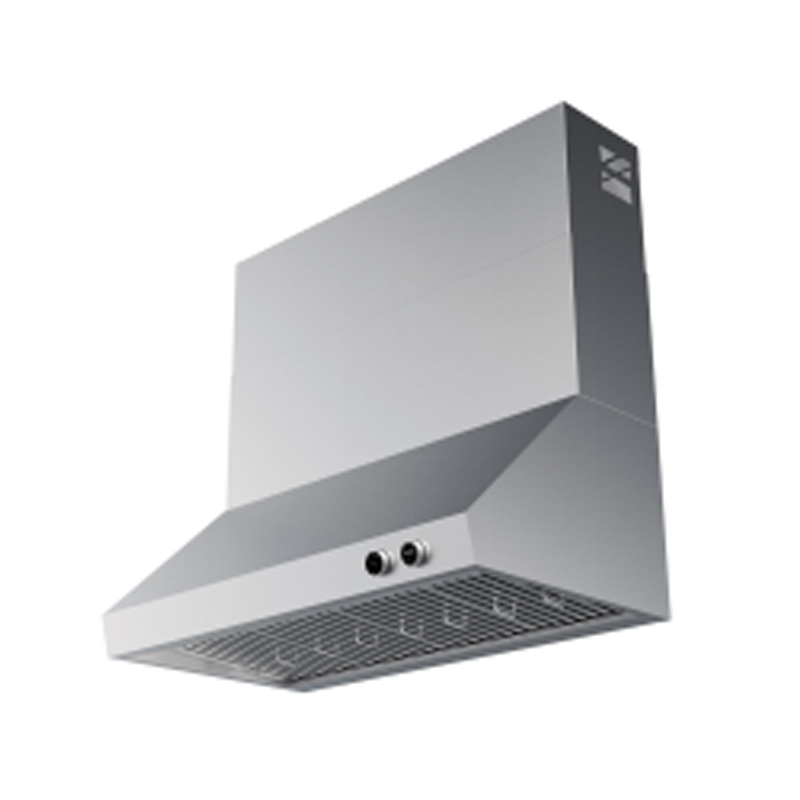
Independent kitchen ventilation studies commonly show that a properly ducted overhead exhaust hood removes a much larger share of airborne grease and combustion byproducts than a recirculating unit, since nothing is trapped and reintroduced into the room. The chart below summarizes typical removal performance reported across residential test kitchens.
| Feature | Ducted Range Hood | Ductless Range Hood |
|---|---|---|
| Air destination | Vented outside | Recirculated indoors |
| Filter type | Baffle or mesh grease filter | Grease filter plus charcoal filter |
| Odor removal | Complete removal | Partial reduction |
| Installation complexity | Requires vent pipe run | No exterior penetration needed |
Noise Levels Between the Two Systems
Noise output depends more on fan speed setting and duct resistance than on venting method alone, but ducted systems generally run quieter at a given CFM because the resistance of a well-sized duct run is lower than the resistance created by a dense charcoal filter stack in a ductless unit. Sound is typically measured in sones, and a well-designed hood should stay below 3 sones on low speed and under 7 to 8 sones on high speed. A hood that exceeds these ranges on its lowest setting is usually undersized for the CFM it is trying to move, which forces the motor to work harder than it should for everyday cooking.
Kitchen size also plays a role in which path makes sense. A compact galley kitchen with a single burner run can often get by with a modest ductless unit, while an open-plan kitchen attached to a living area benefits far more from a ducted setup, since recirculated cooking odor has nowhere to dissipate in a large shared space. Homeowners comparing range hood options for a renovation should treat the venting method as the first decision, before finish, width, or mounting style, because it determines what construction work is required behind the scenes.
How an Overhead Exhaust Hood Removes Grease, Smoke, and Heat
An overhead exhaust hood works by creating a capture zone directly above the cooking surface. Rising heat carries smoke, moisture, and airborne grease particles upward into that zone, where the fan draws the mixture through a metal filter before pushing it toward the vent pipe or the recirculation outlet.
Two numbers determine how well this process works in practice: the fan rating measured in cubic feet per minute, and the size of the capture area relative to the burners below. A hood that is too narrow or mounted too high will let smoke escape around the edges no matter how strong the fan is rated. A recessed range hood, which sits flush with the underside of a cabinet, needs a slightly higher CFM rating than a projecting hood of the same width because it captures air from a shallower zone.
Fan strength alone does not guarantee performance once ductwork enters the picture. Every foot of pipe, every elbow, and every transition fitting adds resistance that reduces the actual air volume reaching the exterior vent. The line chart below illustrates how measured airflow typically drops as duct length increases for a mid-size residential unit rated at 600 cubic feet per minute.
This is why duct routing matters as much as fan selection. A short, straight run to an exterior wall preserves far more of the rated airflow than a long path with multiple turns toward the roof.
Capture Area and Mounting Height
Mounting height directly affects how much smoke actually reaches the filter. An overhead exhaust hood placed too far above the cooking surface loses much of its capture efficiency, since rising heat disperses sideways before it reaches the intake. Most manufacturers specify a mounting range between 24 and 30 inches above the cooktop for standard hoods, with a narrower range for a recessed range hood because its shallower profile leaves less margin for error.
CFM Sizing by Kitchen Size
A simple sizing guideline used by many installers is to match CFM roughly to burner output and cooking frequency rather than kitchen square footage alone:
- Light home cooking on a standard four-burner range: 300 to 400 CFM
- Frequent cooking or a six-burner range: 400 to 600 CFM
- Heavy searing, wok cooking, or a professional-style range: 600 to 900 CFM
Oversizing the fan without matching duct diameter creates the pressure problems described in the ductwork section that follows, so CFM and pipe sizing should always be selected together rather than in isolation.
Range Hood Vent Pipe Sizing and Ductwork Installation Basics
Correct kitchen hood ductwork installation starts with matching pipe diameter to the fan output. Undersized pipe forces air through a narrow opening, which raises static pressure, increases fan noise, and can cut effective airflow by a third or more. Most residential range hood vent pipe runs use six to eight inch round duct, with wider mesh required for high-output commercial-style units.
Rigid metal duct consistently outperforms flexible foil duct because it holds a smooth, constant diameter along its length. Flexible duct is easier to route around obstacles but its corrugated interior surface creates more friction, which shows up as pressure loss.
Installation generally follows a consistent sequence regardless of kitchen layout:
- Confirm the fan CFM rating and select matching pipe diameter
- Plan the shortest practical route to an exterior wall or roof cap
- Limit the number of 90 degree elbows, favoring two 45 degree bends instead
- Seal every joint with metal tape or mastic rather than adhesive tape alone
- Insulate duct runs that pass through unconditioned attic space
- Install a backdraft damper at the exterior termination point
Skipping the backdraft damper is one of the most common installation errors, since it allows outside air and pests to enter the kitchen whenever the fan is off.
Wall Cap vs Roof Cap Termination
Most residential kitchen hood ductwork installation projects terminate through an exterior wall rather than the roof, simply because a wall cap is easier to seal, inspect, and maintain over time. A roof termination is sometimes unavoidable in multi-story homes where no exterior wall sits close to the kitchen, but it adds cost for flashing, requires a steeper duct angle, and makes future cleaning more difficult. Whichever termination point is used, the cap should include a damper flap and a screen to keep out insects and debris.
Sealing quality matters as much as duct diameter. Unsealed joints leak conditioned air into wall cavities and attic spaces, which can lead to condensation and, over years of use, hidden moisture damage. Metal tape rated for HVAC use, or a brush-applied mastic sealant, holds up far longer than standard cloth duct tape, which tends to dry out and separate within a few seasons.
When a Ductless Exhaust Fan for Kitchen Use Makes Sense
Not every kitchen can accommodate a vent pipe run to the exterior. Interior kitchen islands, apartment units with shared walls, and mid-renovation budgets often push homeowners toward a ductless exhaust fan for kitchen ventilation instead. An under cabinet ductless hood mounts directly beneath upper cabinetry and requires no structural modification, which makes it a practical option for rental units and quick upgrades.
The tradeoff is ongoing filter maintenance. Charcoal filters in a ductless system typically need replacement every three to six months depending on cooking frequency, while grease filters on either system need regular cleaning. Because ductless units cannot expel heat and humidity outdoors, kitchens that do heavy frying or wok cooking tend to notice more residual odor and grease film on nearby surfaces over time.
A recessed range hood built into ductless form is also popular in condominiums where the ceiling cavity cannot be opened for pipe routing. It preserves the clean overhead line of the cabinetry while still providing filtered air movement above the cooktop, even though it does not remove moisture from the room the way an exterior vent does.
Filter Maintenance Schedule
Because a ductless exhaust fan for kitchen use depends entirely on its filters to condition the recirculated air, a consistent cleaning schedule matters more than it does with a ducted system:
- Metal grease filters: wash every two to four weeks with degreasing solution
- Charcoal or carbon filters: replace every three to six months depending on cooking frequency
- Fan blades and housing: wipe down monthly to prevent grease buildup that affects motor efficiency
Skipping filter maintenance is the most common reason a ductless unit is perceived as underperforming, since a saturated charcoal filter stops adsorbing odor almost entirely while still allowing air to pass through it.
Wall Mount Ducted Range Hood for Outdoor and BBQ Kitchens
Outdoor kitchens and covered patio cooking stations create a different set of demands. A ducted bbq range hood has to manage far more heat and grease output than an indoor range, since charcoal and gas grills produce sustained high temperatures and heavier smoke volume. A wall mount ducted range hood built for this environment typically uses a higher CFM rating, weather-resistant housing, and a shorter, more direct vent path than an indoor equivalent.
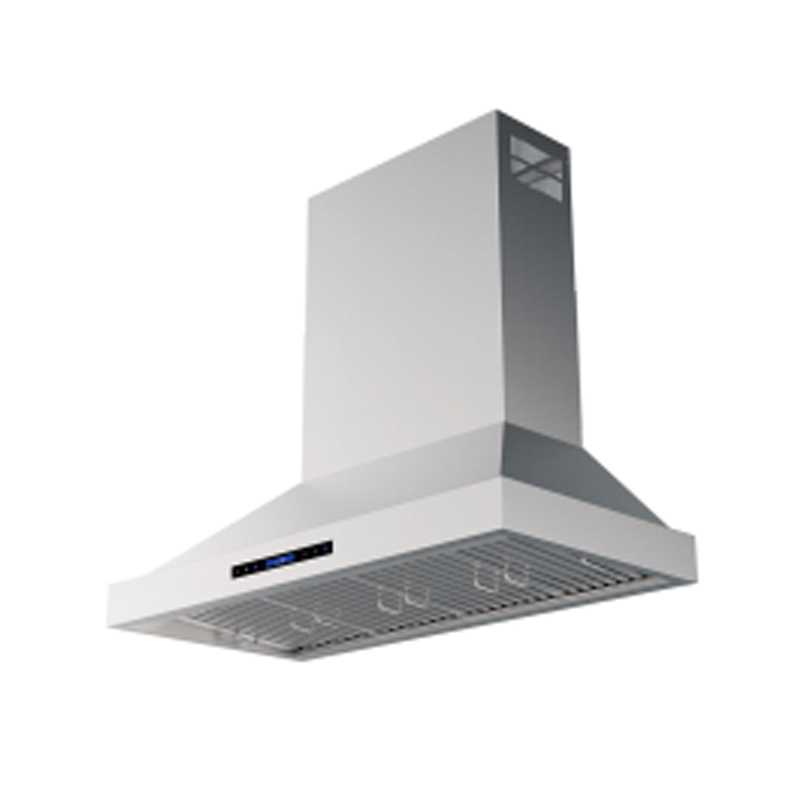
Ductless units are rarely suitable outdoors, since open-air cooking generates more airborne grease than a recirculating filter can reasonably capture, and there is no enclosed room to recirculate air back into. The radar comparison below outlines how ducted and ductless approaches stack up across the factors that matter most for an outdoor BBQ hood.
Ducted outdoor hoods score higher on airflow power, weather resistance, and grease capture, while ductless units only hold an edge on upfront cost and simpler installation, an edge that narrows quickly once outdoor-rated ductwork is compared against the ongoing filter replacement needed for heavy grill use.
Weatherproofing an Outdoor Vent Path
Any wall mount ducted range hood installed outdoors needs housing and hardware rated for direct weather exposure, including gasketed seams, a sloped roof cap that sheds rain rather than collecting it, and corrosion-resistant fasteners. Even a short exterior duct run should be pitched slightly downward toward the termination point so condensation drains outward instead of pooling inside the pipe. In coastal or high-humidity climates, sealed stainless housing outperforms painted or coated steel over the long term, since salt air accelerates corrosion at seams and screw points.
Range Hood Insert vs Standalone Units for Custom Cabinetry
Homeowners building custom cabinetry often choose a range hood insert rather than a standalone hood. An insert is a ducted power unit designed to sit inside a wood, tile, or plaster enclosure built by a cabinetmaker, so only the front grille and controls remain visible. This lets the kitchen design set the visual style while the insert handles the mechanical work of pulling air through the range hood vent pipe.
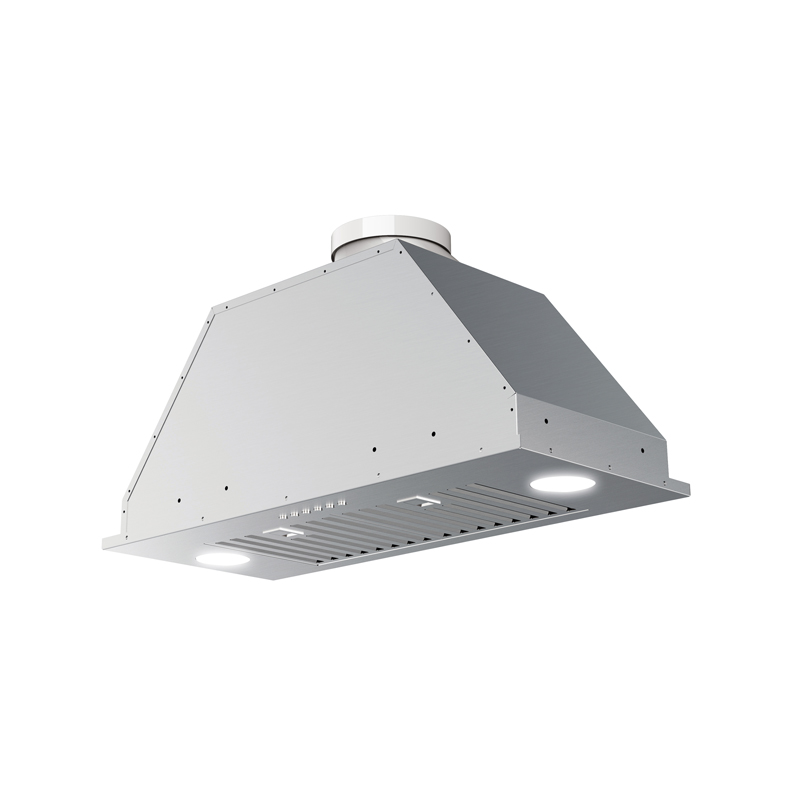
| Consideration | Range Hood Insert | Standalone Hood |
|---|---|---|
| Visible finish | Custom enclosure material | Manufacturer finish only |
| Ducting | Ducted, hidden in enclosure | Ducted or ductless |
| Installation timeline | Coordinated with cabinetry | Independent install |
| Best fit | Custom or renovated kitchens | Standard cabinet layouts |
Because an insert is always ducted, it delivers the same removal efficiency shown earlier in this article, and it works well paired with a recessed range hood profile when the enclosure sits flush with surrounding cabinetry rather than projecting outward.
Enclosure material choice affects both maintenance and airflow clearance. A plaster or drywall enclosure needs an access panel for filter changes and motor service, while a wood enclosure typically incorporates a removable front panel by design. Whatever the material, the enclosure cavity needs enough clearance around the insert body for unobstructed intake airflow, since a tightly packed enclosure can starve the fan and reduce the CFM actually delivered at the filter, even when the insert itself carries a high rated output.
Matching the Venting Method to the Kitchen, Not the Other Way Around
The strongest ventilation decision starts with the space rather than the equipment. A kitchen with easy access to an exterior wall and a moderate renovation budget almost always benefits from a ducted overhead exhaust hood, since it removes heat, moisture, and odor completely instead of filtering and returning them to the room. A kitchen constrained by structure, lease terms, or a tighter budget can still achieve meaningful air quality improvement with a ductless exhaust fan for kitchen use, provided the filter maintenance schedule is followed closely rather than treated as optional.
Outdoor and BBQ installations sit at the opposite end of the spectrum, where ducted venting is close to mandatory given the volume of smoke and grease produced by open-flame cooking. Custom kitchens leaning on a range hood insert inherit the full performance of a ducted system while keeping the visible design entirely in the hands of the cabinetmaker. In every case, pairing the correct duct diameter, mounting height, and CFM rating to the specific cooking habits of the household matters more than any single spec sheet number on its own, and it is worth confirming those figures with an installer before committing to a duct route or an enclosure design.
Frequently Asked Questions About Ducted and Ductless Range Hood Venting
Q1: Which system removes more cooking odor, ducted or ductless?
A ducted system removes odor more completely because contaminated air leaves the building instead of passing through a charcoal filter and returning to the room. Ductless systems reduce odor but rarely eliminate it entirely, especially after the filter has been in use for a few months.
Q2: Can a ductless exhaust fan for kitchen use be converted to ducted later?
In many cases yes, provided the wall or ceiling cavity behind the unit allows a vent pipe route to an exterior wall or roof. The conversion usually requires removing the recirculation filter housing and adding matching duct, a backdraft damper, and an exterior cap.
Q3: How long can a range hood vent pipe run before performance suffers noticeably?
Performance loss becomes noticeable once a run passes roughly 25 to 30 feet or includes more than three elbows, particularly with flexible duct. Keeping the path short and using rigid metal pipe preserves more of the rated airflow.
Q4: Is a recessed range hood as effective as a projecting hood?
Yes, provided it carries a higher CFM rating to compensate for its shallower capture zone and is sized appropriately to the width of the cooking surface below it.
Q5: Do outdoor BBQ hoods need a different duct material than indoor kitchen hoods?
Outdoor installations generally require weather-resistant duct and termination hardware rated for exterior exposure, along with shorter runs to manage the higher heat and grease volume produced by grilling.
Q6: What CFM rating is appropriate for a typical home kitchen?
Most home kitchens with a standard four to six burner range fall in the 300 to 600 CFM range, with heavier cooking styles such as wok searing or a professional-style range pushing that number toward 600 to 900 CFM.
Q7: Should a range hood insert always be ducted?
Yes, inserts are designed to be built into a custom enclosure and sit inside cabinetry with a hidden vent path, so they are manufactured as ducted units rather than recirculating ones.
